🧠 Critical Thinking
Introduction
What you'll learn: by the end of this tutorial, you'll know how to defend yourself against false information, misleading numbers, and manipulative arguments — whether in a WhatsApp message, a political speech, an advertisement, or even an answer from artificial intelligence.
Critical thinking is not a gift reserved for a few brilliant people. It is a skill — like driving or cooking — that you learn with a method and practice. And it is the most important skill of the 21st century: every day we receive more information than our grandparents received in a month, and much of it is false, exaggerated, or designed to manipulate us.
What is critical thinking?
Critical thinking is the habit of not accepting a claim simply because it is presented to us — but of examining it before believing it. "Critical" does not mean "negative": it comes from the Greek kritikos, which means "able to judge, to distinguish."
Someone who thinks critically asks three basic questions in front of any piece of information:
- Is it true? What is the evidence? Where does the information come from?
- Is it complete? What aren't they telling me? What context is missing?
- Why are they telling me this? Who is speaking, and what is their interest?
The opposite of critical thinking is automatic thinking: believing and sharing immediately because the information confirms what we already thought, or because it triggers a strong emotion (fear, anger, pride). 🇭🇹 Lè yon enfòmasyon fè w fache oswa fè w pè twò vit, se la pou w fè atansyon. (When information makes you angry or afraid too quickly, that's when to be careful.)
The biases that fool us
A cognitive bias is an automatic mental shortcut. Our brain uses hundreds of them to move fast — but these shortcuts often lead us into errors of judgment. Knowing a few of them is already a form of protection. Here are the four most dangerous:
1. Confirmation bias
We more easily believe what confirms our ideas, and reject what contradicts them. If you already think a politician is corrupt, you'll share any rumor against them without checking — and doubt every piece of good news about them. The test: "Do I believe this because it's proven, or because it suits me?"
2. Authority bias
We believe a claim because it comes from a doctor, a pastor, a teacher, or a well-known personality — even when they speak about a subject outside their field. A good doctor is not necessarily a good economist. The test: "Is this person truly an expert on THIS specific subject?"
3. Group bias
We more easily believe what the people of our family, our church, our party, our country believe. "Everyone says so" is not evidence. The test: "If a person I dislike said this, would I believe it?"
4. Emotional bias
The more a piece of information touches us (fear, anger, hope), the less we verify it. This is exactly what fake news seeks: it is designed to make us react, not to inform. The test: "Is this information trying to inform me, or to make me react?"
Free sources: Pexels / Unsplash, or your own photo. Replace this block with <figure class="tuto-fig"><img …><figcaption>…</figcaption></figure>.
Evaluating a source
Before believing information, look at where it comes from. A simple four-letter method — the SAVD method:
| Letter | Question | Example red flag 🚩 |
|---|---|---|
| S — Source | Who published it? A known outlet, an institution, or an anonymous account? | "Shared by a friend of a friend" |
| A — Author | Who wrote it? Do they have competence on the subject? | No name, no date |
| V — Verifiability | Does the information cite evidence you can check? | "Studies show that…" (which ones?) |
| D — Date | When was it published? Is it still current? | An old photo presented as recent |
The golden rule: important information should be confirmable by at least one independent second source. If only one person or one site says it, and no one else mentions it, be wary.
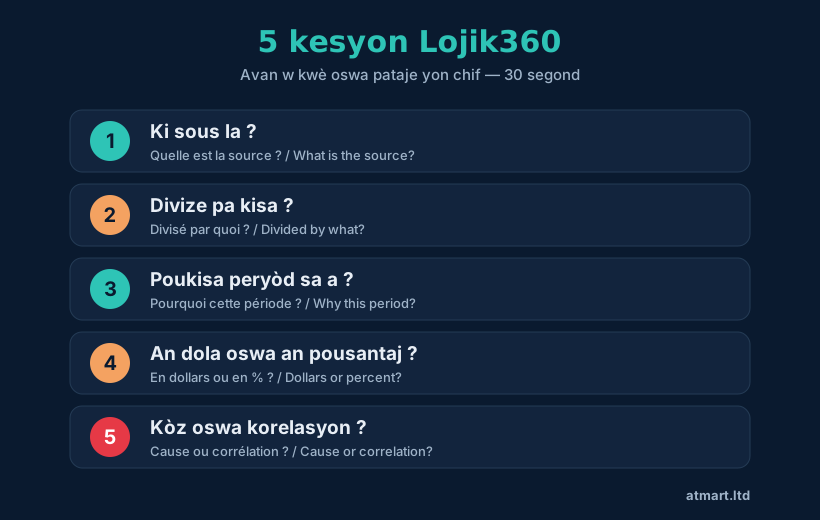
The 5 Lojik360 questions
Here is the central tool of this tutorial — the same one as in episode 1 of the podcast. Before believing or sharing a statistic or a claim, ask these five questions. Thirty seconds is enough.
- Ki sous la? (What is the source?) — and can I verify it myself?
- Divize pa kisa? (Divided by what?) — that big number, divided by what? (per person? per year?)
- Poukisa peryòd sa a? (Why this period?) — what does the full picture show?
- An dola oswa an pousantaj? (Dollars or percent?) — if I switch units, does the story change?
- Kòz oswa korelasyon? (Cause or correlation?) — am I being shown a link, or proven a cause?
Let's take a real example. The Haitian diaspora sent $4.1 billion to Haiti in 2024 (source: World Bank). This number is true. Yet it can be used to deceive:
- "4 billion! Haiti is rich!" → Question 2: divided by 11.7 million inhabitants = about $350 per person per year. Less than a dollar a day.
- "The diaspora sends less and less" → Question 3: false if you look from 2000 ($600 million) to 2024 ($4.1 billion). Multiplied by 7 in 25 years.
Same true number, opposite conclusions. Whoever chooses how to present the number chooses the conclusion.
Spotting number manipulation
Numbers look objective, so we trust them more — and that is exactly what makes them dangerous. Here are the most common manipulations:
The big number with no context
"The project cost 500 million gourdes!" A lot or a little? Without a point of comparison (per inhabitant, relative to the total budget, compared to last year), a number alone means nothing.
The percentage that hides the real number
"Sales rose 100%!" If you went from 2 to 4 customers, it's true… and insignificant. Conversely: "only 0.1% increase" can represent millions of people in a large country.
The misleading chart
A vertical axis that doesn't start at zero can turn a small variation into a spectacular cliff. Always look at the numbers on the axes, not just the shape of the curve.
Correlation disguised as cause
Two things that rise at the same time are not necessarily linked by a cause. "Since remittances have been rising, poverty has risen too" — but it's probably the reverse: it's because the situation is worsening that the diaspora sends more. Correlation does not mean causation.
Building a solid argument
Thinking critically is not only about spotting other people's errors — it's also about reasoning correctly yourself. A good argument has three parts:
- A claim (what you're defending)
- Evidence (facts, data, sources)
- A logical link (why this evidence supports the claim)
Also learn to recognize the most frequent dishonest arguments:
- The personal attack (ad hominem): attacking the person instead of their argument. "You can't talk about the economy, you don't even have a degree."
- The false dilemma: presenting only two options when others exist. "Either we accept this project, or the country collapses."
- The appeal to fear: replacing evidence with a threat.
- The straw man: distorting the other's argument to destroy it more easily.
Critical thinking in the age of AI
Artificial intelligence (ChatGPT, Claude, Gemini…) and generated images make critical thinking more necessary than ever. Two new reflexes:
Verify AI answers
An AI can write a perfectly fluent answer… that is completely false (this is called a "hallucination"). It sometimes invents numbers, dates, quotes. Rule: never publish a fact given by an AI without verifying it in a real source. AI is an assistant, not an authority.
Recognize fake images and videos (deepfakes)
It is now easy to generate a very realistic fake photo or video. Before believing a shocking image:
- Look for the same image elsewhere (reverse image search on Google Images).
- Look at strange details: distorted hands, unreadable text, inconsistent shadows.
- Ask yourself: "Does a single source show this, or do several serious outlets confirm it?"
Practice exercises
Actually do them — that's what turns reading into a skill.
Exercise 1 — The WhatsApp message
You receive: "URGENT!! 80% of the money sent by the diaspora is wasted by the State. Share before they delete this message!!" List at least three red flags.
See the solution
1) No source (Question 1: ki sous la?). 2) The "80%" figure is orphaned — which study, which year, which definition of "wasted"? 3) The urgency and "share before deletion" are emotional-manipulation techniques. 4) The word "wasted" is vague and biased. → We don't share.
Exercise 2 — The news headline
A site runs the headline: "Unemployment exploded by 50%!" What questions do you ask before believing it?
See the solution
50% relative to what and over what period (Question 3)? In absolute value, how many people does that represent (Question 2: a percentage hides the real number)? What is the source (Question 1)? Is it a real rise or a change in the calculation method? Does a single site say it, or is it confirmed?
Exercise 3 — Spot the bias
A friend says: "My pastor said this medicine cures diabetes, so it must be true." Which bias do you recognize?
See an example answer
Authority bias: a pastor is a spiritual authority, not a medical authority. The right question: "Is there published, verifiable medical evidence that this medicine cures diabetes?" Often, on top of that, a group bias (we trust because it's someone from our community).
Conclusion & going further
Critical thinking comes down to one habit: slow down before believing. In front of every important piece of information, take thirty seconds to ask where it comes from, what it hides, and why it's being presented to you. 🇭🇹 Pa kwè twò vit, pa pataje twò vit. Panse anvan. (Don't believe too fast, don't share too fast. Think first.)
What you learned:
- Recognize the 4 biases that fool us
- Evaluate a source with the SAVD method
- Apply the 5 Lojik360 questions to any statistic
- Spot number manipulation and dishonest arguments
- Keep a critical mind in the face of AI and deepfakes
- 🎙 Listen to episode 1 of Lojik360: "How you're fooled with statistics."
- 📊 Put theory into practice with "Excel: your first analysis" and the free remittances dataset.
- 🎓 To go further, the Critical Citizen track (free, 7 lessons by email).